Poster Presentations at Asilomar Conference 2025
Date:
I presented two posters at the 2025 59th Asilomar Conference on Signals, Systems, and Computers (Oct 26-29).
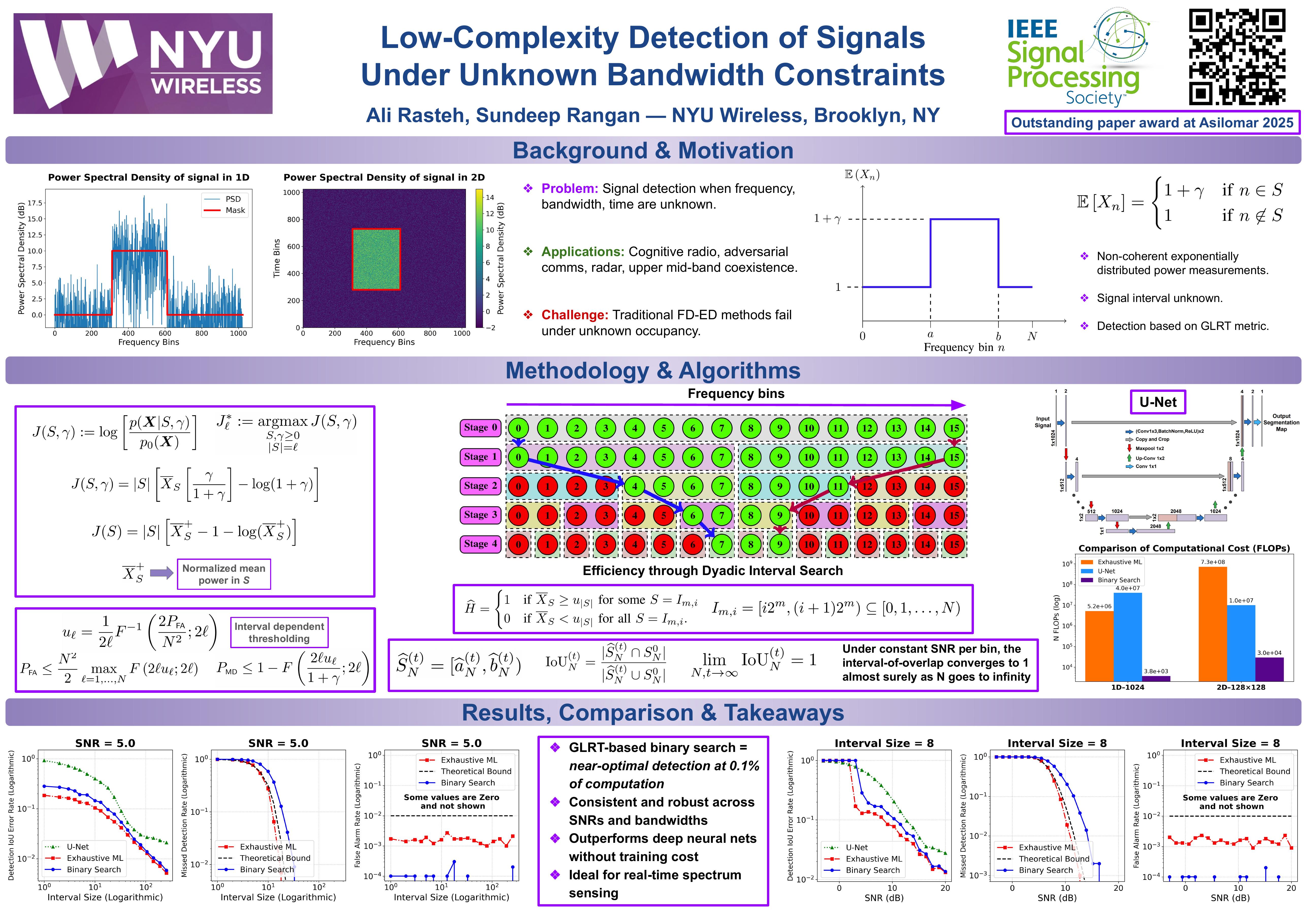
1. Low-Complexity Detection of Signals Under Unknown Bandwidth Constraints (Ali Rasteh, Sundeep Rangan), which received the Outstanding Paper Award at the conference. The work addresses signal detection when the frequency, bandwidth, and time of occupancy are all unknown, a regime where traditional frequency-domain energy detection methods break down. We formulate the problem with a GLRT metric over non-coherent, exponentially distributed power measurements and show that a dyadic interval binary search achieves near-optimal detection at roughly 0.1% of the computational cost of exhaustive maximum likelihood. The method is consistent and robust across SNRs and bandwidths, and outperforms a U-Net deep neural network baseline without incurring any training cost, making it well suited to real-time spectrum sensing. Applications include cognitive radio, adversarial communications, radar, and upper mid-band coexistence.
You can find the poster Here, the code in our Github Repo, and the related publications Here and Here.
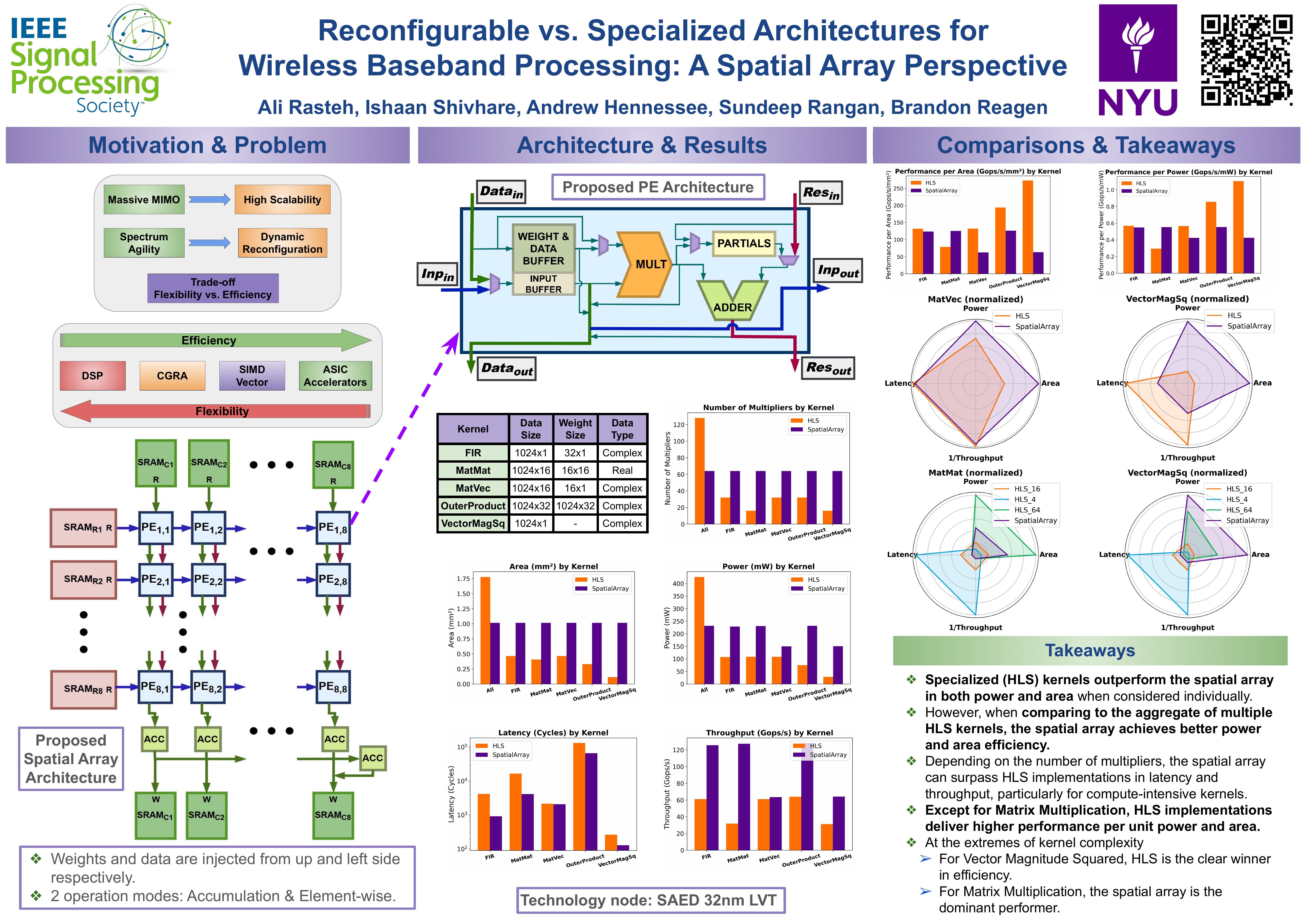
2. Reconfigurable vs. Specialized Architectures for Wireless Baseband Processing: A Spatial Array Perspective (Ali Rasteh, Ishaan Shivhare, Andrew Hennessee, Sundeep Rangan, Brandon Reagen). This poster examines the flexibility-versus-efficiency trade-off in baseband hardware for massive MIMO and spectrally agile systems. We propose a reconfigurable spatial array of processing elements with weight and data injection from the top and left edges and two operating modes (accumulation and element-wise), synthesized in a SAED 32nm LVT technology node, and compare it against specialized High-Level Synthesis (HLS) kernels across FIR filtering, matrix-matrix and matrix-vector multiplication, outer products, and vector magnitude squared. Individually, HLS kernels win on power and area, but against the aggregate of multiple HLS kernels the spatial array is more power and area efficient, and it dominates on latency and throughput for compute-intensive workloads such as matrix multiplication, while HLS remains the clear winner for lightweight kernels like vector magnitude squared.
You can find the poster Here and more details on the project page.
Our Posters (Click to see all images)